Building a secure future for members, the environment and the Gwydir Valley community through irrigated agriculture

Gwydir Valley Irrigators Association

The Gwydir Valley Irrigators Association (GVIA) represents in excess of 400 water entitlement holders in the Gwydir Valley.

Our water entitlement holders are some of the most progressive in the world, actively engaged in, and innovating irrigated agriculture. From broadacre crops such as cotton to tree crops such as pecans, oranges and olives, our industry is diverse and productive. We are all acutely aware that reliability of water in the valley is low, and thus strive to Make Every Drop Count for the producer, the community and the environment. Read more about us

Making Every Drop Count

Securing a future for the Gwydir Valley through Irrigated Agriculture.


Water Allocations

GVIA Members

Become part of a united voice advocating for the future of irrigation in the Gwydir Valley.

Water Policy

Championing fair, transparent, and sustainable water policy for the Gwydir Valley.

Community & Industry Initiatives

Partnering for progress across the Gwydir Valley.

The Gwydir Valley

The Gwydir Valley is a highly productive rural region located in North West NSW, characterised by rich alluvial soils.

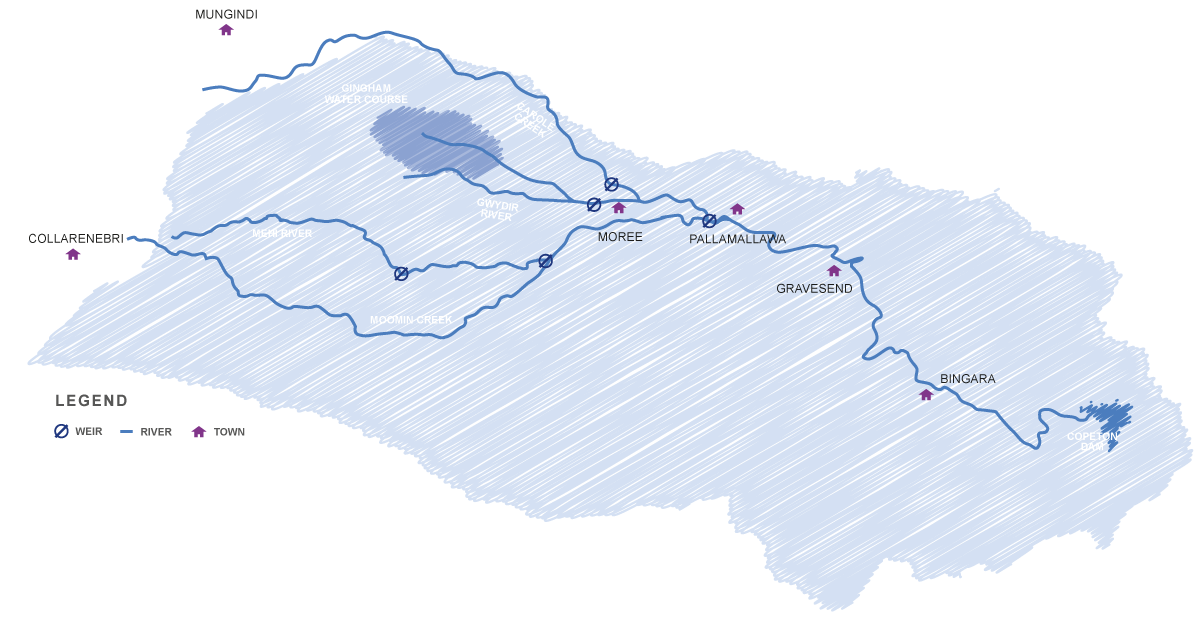
The Gwydir River System

×

Olives

The irrigated olive industry was initiated in the Gwydir Valley over 25 years ago. Olives are a vertically integrated industry with the nationally recognised Gwydir Grove Olives the largest local producer and processor. In recent years the number of olive trees has declined as some producers have switched from olives into pecans.

Read more

×

Oranges

Oranges are a new irrigation industry in the Gwydir Valley, with the majority of the trees planted since 2005. It is currently expanding with an expected area of 350Ha to be under production by 2020. The citrus industry in the Gwydir Valley is part of the locally owned and vertically integrated Grove Juice business.

Read more

×

Pecans

The pecan industry is an important irrigation industry for the Gwydir Valley. Trawalla, owned and operated by Stahmann Farms is the largest in the region producing approximately 90% of Australia’s pecans. Australia is the fourth largest global producer of pecans. Stahmann Farms operate the country's only commercial pecan shelling, value-adding and packing plant.

Read more

×

Broadacre Cropping

The Gwydir Valley is a diverse broadacre cropping region producing a range of both summer and winter crops. The primary winter crops include; chickpeas, wheat, barley, and more recently canola. While summer plantings include sorghum, faba beans, mung beans, maize and sunflowers. The majority of the broadacre cropping area is dryland.

Read more

×

Cotton

Cotton is the most significant irrigated crop in the Gwydir Valley with an average of 70,000Ha. It is also an important dryland crop with an average of 79,000Ha annually. The area planted can fluctuate from year to year, being dependant on either available irrigation water and seasonal rainfall.

Read more

×

Lucerne

Lucerne and Hay are niche crops in the Gwydir Valley covering an estimated 4,500Ha. Lucerne is produced primarily on smaller blocks and is irrigated by bore water entitlements. Hay production includes Lucerne, cereals and pastures.

Read more

×

Turf

The turf industry has been a part of the irrigation industry of the Gwydir Valley for almost 20 years, but there are only two producers in the valley. It covers a very small area of only 20Ha and is irrigated by bore water entitlements. The primary species produced is Buffalo.

Read more

×

The Gwydir Wetlands

The Gwydir Wetlands are a system of terminal delta wetlands, located downstream of the Gwydir River approximately 45kms west of Moree in north west NSW. They are recognised for their unique vegetation and bird breeding potential. The wetlands are estimated to consist of approximately 6,829Ha of semi-permanent wetland and 77,949Ha of floodplain wetland.

Read more

×

Gwydir River - Gravesend Monitoring Gauge

WaterNSW monitor 51 river gauge locations in the Gwydir River and streams(418) using telemetry with data accessible in real time. These sites collect a range of information from flow rate, discharge volume and river heights and assist WaterNSW in their role of water delivery operators whilst providing an indication of water availability.

Water NSW Real Time Data

×

Water Management

All water in the Gwydir is managed by water sharing plans established progressively since 2004. Currently 19% of long term Gwydir river flows and 85% of sustainable yield of the Lower Gwydir aquifer are available for irrigation. This has been reduced over time following reforms and water recovery for environment.

WATER SHARING PLANS AND OR WATER AVAILABILITY

×

Groundwater Monitoring Network

The are a number of groundwater sources including the Lower Gwydir aquifer used for irrigation and the Great Artesian Basin, including recharge zones. WaterNSW monitor levels via 26 monitoring sites with data accessible in real time.

Groundwater provides reliable irrigation water, quality drinking water for towns and properties and is one of the region’s major tourism attractions.

Read More

×

Copeton Dam

Copeton Dam is located on the Gwydir River upstream of Bingara on the north-west slopes of NSW. It is one of the largest inland dams in NSW with a capacity of 1,364,000 megalitres of water. It was initiated in 1966 to provide town water supplies and to boost irrigated agricultural production in the Gwydir Valley.

WATER SHARING PLANS AND OR WATER AVAILABILITY

Latest News & Events

FPH storage classification

Some members with FPH licences will not be using all storages in their works approvals to take water when the opportunity occurs. If this is the case you will need to make these storages inactive, now referred to as "classified as not taking licensed water".
These storages  can be made active into the future if your situation changes. Please read the guide, and or watch the video. 
Please follow the link included. Scroll down to the section Amend the works as not taking FPH water

Amend - To ensure your approval is correct, it's your responsibility to confirm that your approval matches the works listed.
Select Works that are classified as not taking licensed water
To classify your work as not taking licensed water (water supply work or floodplain harvesting), please login or register in the Customer Portal and complete the ‘Amend the status of your work’ form.

Please note: There may already be a pre-populated status for your work in the Customer Portal based on our records. If there isn’t a status pre-populated or the status selected is incorrect, please select the correct classification to describe your work.

Further information:

Classification of Works

Entitlement holders in the Gwydir will have received letters regarding works Classifications. We have requested that additional information be provided to you to assist in completing the classification of works. In preparation, we suggest you register on the WaterNSW customer portal.

  • Customers will receive an email confirmation whether you are approved, rejected or require further information to complete the registration.
  • If the approval or licence belongs to a Business, you will need to create a business profile using the manage business function in your customer portal. A video guide is available here
  • WaterNSW will merge existing approvals and licences onto your profile in the portal, this may take up to 5 days
  • Customers will then receive an email notification to review and approve the LNK case in your profile, if something doesn’t look right, reply back to the email asap to have it rectified
  • The portal will provide all the necessary information (work ID, WAL, Works Approval etc).
  • Customers will also be able to see a map showing where the works are currently located.
  • If you need assistance, you can book a phone appointment with the WaterNSW team by clicking here or call 1300 662 077. You can also email licensing@waternsw.com.au for specific questions or assistance

The MDBA will be meeting with community outside Brookers Trading on Balo St for 2-4pm on Monday 30th March

The GVIA will be hosting the MDBA at our office at 10:00 am on Tuesday 31st March - Please join us. 

The key messages are detailed in the attached file. In summary
-  No Rule Changes, compulsory acquisition is not appropriate
-  No more water from Agriculture, 72% of water is already for the environment
-  Community supported constraints must be completed, the NSW government must be held accountable
-  Complementary measures such as carp control must be implemented
-  Infrastructure must be updated at Menindee and to provide critical needs
-  Socio-economic impacts must be recognised appropriately
-  The Gwydir SDL do not need adjusting